

The ARC Framework

The pace of change has outrun the speed at which individuals can adapt. People adapt faster than organizations change. Business forces, competitive pressure, and technological acceleration keep compounding. Leaders need the organizational capacity to hold their footing when conditions shift.
ARC develops Adaptability, Resilience, and Confidence.
In every engagement we have run, the pattern repeats. The technology is not the problem. These three capabilities determine whether an AI program produces results. Weak on any one, and the investment stalls. Strong on all three, and results follow.
Generative AI produces outputs for human review. Agentic AI acts without waiting for one. Both are part of an acceleration that will continue. ARC was built knowing this would not be the last disruption.
ARC is grounded in decades of peer-reviewed evidence across cognitive science, human factors engineering, behavioral economics, decision science, and organizational psychology. We discovered it through pattern recognition across 80+ AI transformations. We did not invent it as a consulting framework.
Adaptability
Learning at the pace the technology demands.
Most organizations struggle with this because their learning cycles are performative. Pilots get launched. Results get reported. The underlying model stays unchanged. Genuine adaptability requires structured encounters with real failure cases: moments where the existing framework breaks down and creates openness to a new approach.
Giving people the ability to modify AI outputs sustains adoption through inevitable rough patches. Organizations that sustain AI adoption plan for error recovery from the start.
Agentic systems execute faster than human review cycles, making real learning loops a requirement rather than a preference.
Resilience
Trust built before it is tested.
Workers pull back from AI the moment it becomes visible to the people evaluating them, even when told they will be judged only on the quality of the output. The worry about being seen as dependent on AI spreads quietly. When an organization holds people implicitly responsible for AI-assisted mistakes, pulling back is the rational move.
Explicit accountability structures decide whether people engage honestly with AI. Aviation and medicine learned this the hard way. Protective conditions produce results when they are built into the workflow rather than added after a failure.
With agentic AI, who owns the outcome becomes a legal and operational question. It needs an answer before deployment, not after the first error.
Confidence
Knowing what to trust and when to act.
Uncertainty is permanent. The leaders who perform well under it know where they stand, what they do not know, and what they are doing next. Acknowledged uncertainty builds more trust than performed certainty.
Generative AI is designed to feel authoritative whether or not it is accurate. Harvard research found that forming an independent judgment before seeing the AI's recommendation reduces over-reliance more than any disclaimer. Microsoft Research found that adding citations to AI outputs increased over-reliance, because users read the citations as a signal of reliability.
Agentic systems act without waiting for approval. Leaders who have not built calibrated confidence for generative AI carry real exposure when those systems stop asking.
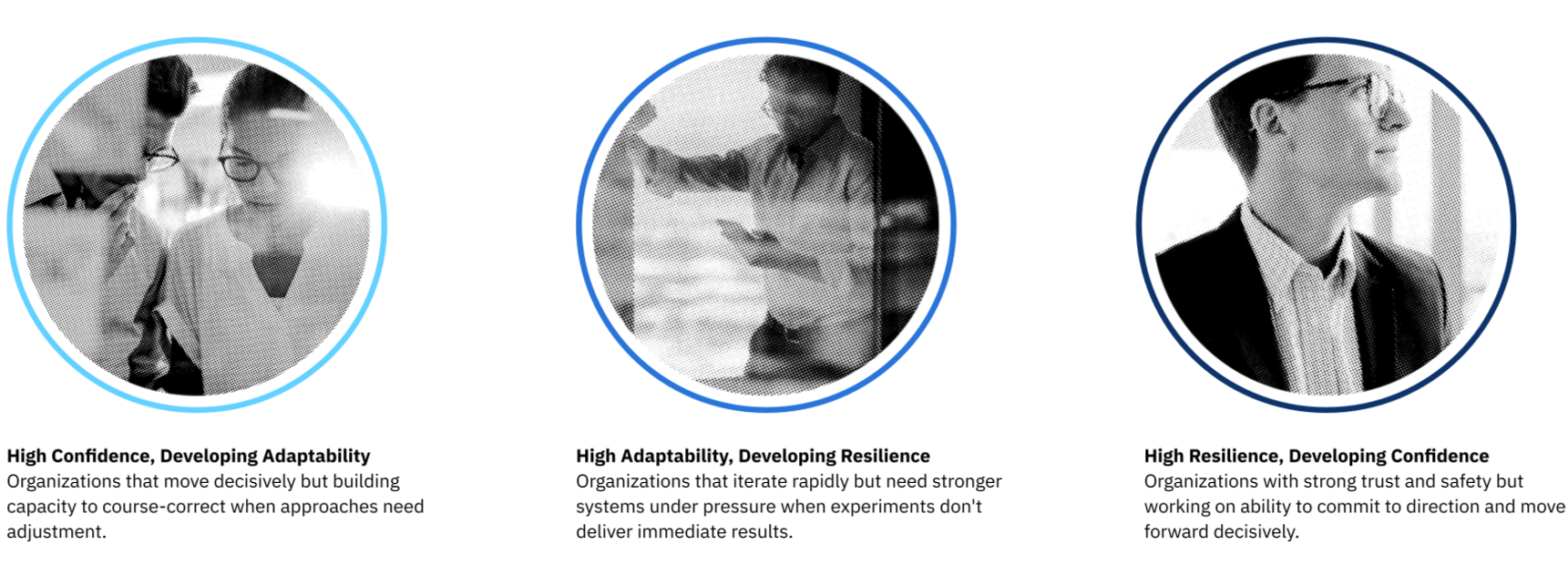
The ARC Index
Readiness is a score, not a feeling.
Our diagnostic measures organizational health across five dimensions: learning loops, error attribution, psychological safety, leadership communication, and environment design. Each dimension is assessed across three lenses: current capability, structural barriers, and readiness for scale.
In thirty minutes, you get a clear score across all three ARC components. The specific gaps costing you revenue and time. A 30-day action plan.
Learn more about the research foundation →
Agentic AI
Agentic AI is one example of the acceleration already underway. Systems that act on their own raise the stakes on every ARC capability: faster errors, widening accountability gaps, and leadership decisions executing without a human in the loop.
Organizations that deploy agentic systems before closing their generative AI gaps will find errors executing at scale before anyone reviews them. The cost of recovering, in time, accountability, and market position, runs far higher than the cost of building the capability now.
The organizations that build Adaptability, Resilience, and Confidence now will be ready for what comes next. The ones that wait will not be starting from zero. They will be recovering from something.
Frequently Asked Questions
-
Human Pilots AI is an AI adoption advisory firm founded by Sean Wood.
It helps organizations move AI from pilots into daily operations by redesigning workflows, improving adoption, and building operating models that sustain usage.
-
The ARC Framework is a model from Human Pilots AI that explains enterprise AI adoption success or failure.
ARC stands for Adaptability, Resilience, and Confidence. These three factors determine whether AI becomes embedded in workflows or remains at the pilot stage.
-
AI adoption in enterprises is the process of integrating AI into real business workflows so it changes how work is done.
IMost AI adoption breaks down inside workflows, not in the tools themselves.
It happens when teams actually change how work gets done—how tasks are routed, how decisions are made, and what gets automated versus reviewed. If those patterns don’t shift, AI stays stuck in pilots or side use.
-
Enterprise AI programs fail because adoption is not designed into workflows.
Common causes include unclear ownership, unchanged processes, low user trust, and measuring success by tool usage instead of business outcomes.
-
ARC improves AI ROI by focusing on workflow integration instead of tool deployment.
It identifies where time is lost in processes, removes friction in execution, and embeds AI into repeatable work patterns. This increases sustained usage and operational impact.
-
An AI operating model is how AI is embedded into organizational workflows and decision-making.
It defines how work is structured, where AI is used, how decisions are made with AI input, and how performance is measured.
-
They fail when the rollout assumes behavior will adjust automatically.
In practice, teams:
keep legacy steps in place
bypass new tools under time pressure
lack clarity on what “good use” looks like
measure usage instead of outcomes
So adoption looks good on paper but doesn’t hold in execution.
-
An organization is ready for AI at scale when workflows are defined, leadership is aligned, and teams can absorb change without disruption.
If these conditions are missing, AI adoption typically stalls after pilot programs.
-
ARC measures organizational readiness for AI adoption.
It evaluates three dimensions:
Adaptability: speed of workflow change
Resilience: stability during transformation
Confidence: trust in AI-assisted decisions
-
ARC connects AI to business outcomes by linking adoption to productivity and cycle time reduction.
It focuses on measurable changes in execution such as reduced manual work, faster throughput, and improved operational capacity.
-
Yes. ARC is often used before implementation to assess adoption risk.
It identifies workflow constraints, organizational friction points, and likely failure areas before scaling AI investment.
-
Traditional AI consulting focuses on technology deployment.
ARC focuses on adoption inside real workflows. It prioritizes behavior change, process redesign, and sustained usage over tool implementation.
-
Human Pilots AI delivers sustained AI adoption inside enterprise workflows.
Outcomes include improved process speed, reduced manual effort, higher AI usage consistency, and successful transition from pilots to production use.
-
The ARC Framework was developed by Sean Wood, founder of Human Pilots AI, Greg Storey and Matt Fangman.
It is based on enterprise AI transformation patterns observed across multiple large-scale organizational deployments.