High Adoption, Low Transformation: Why Most AI Pilots Fail to Deliver
The fix requires more courage than money.
A CEO told us last month: "We've been at this for two years. We've got AI tools in most departments. Finance, HR, operations…everyone's using something. But explaining to the board what we've accomplished sounds like activity and not much outcome. I feel them losing patience."
We've heard variations of this confession from 20+ mid-market executives this year across manufacturing, financial services, and healthcare. The details change — different industries, different tools, different budgets — but the core problem doesn't. Usage is up. Spending is up but transformation isn’t clear.
The data confirms what you already feel. 80% of AI initiatives fail within a year (BCG, 2024). Among companies that launched 100+ use cases, only 19% can point to actual business outcomes. Maturity scores dropped 9 points this year despite higher adoption rates.
This isn't an adoption problem. You adopted. This is a capability problem your organization isn't built to solve.
The Rational Trap
For two years, companies treated AI as a software upgrade. The logic seemed sound. Buy the best models, distribute licenses, wait for results.
But there's an uncomfortable reality underneath the hype. 77% of employers now require AI adoption. Meanwhile, 70% of workers aren't prepared to use these tools (MIT/BCG, 2024). Nearly half of leaders worry about their own jobs.
So executives do what makes sense under quarterly pressure: launch point solutions. Another chatbot. Another automation tool. Each one defensible on its own. Each one approved in isolation. Each one making real transformation more expensive.
We sat with a CIO last quarter who walked us through 23 separate AI pilots his company had running. Different vendors. Different teams. Different success metrics. When we asked how they'd connect these into a coherent system, he went quiet. "We haven't gotten there yet."
That's the trap. These disconnected pilots create technical debt and integration costs. Success stays localized with whoever championed the project. When that person leaves, their knowledge walks out the door.
You're not just failing to transform. You're making transformation harder.
An executive recently told us: "We don't have time to build a strategy. The board wants to see what we've launched."
The pressure to show activity crowds out the work of building capability. Quarterly earnings optics, board patience for visible progress, vendor relationships that reward launches over outcomes. The incentives all push away from work that matters.
What the 20% Do Differently
The companies escaping this trap aren't smarter. They don't have bigger budgets or more patient boards. They measure different things.
Most executives track licenses deployed, prompts run, use cases launched. These are activity metrics. They tell you what people are doing, not whether it matters.
The difference comes down to three capabilities.
Adaptation. Can your workflows change when AI suggests a better approach? Most can't. Processes are locked in systems that took years to build. One manufacturing client told us their ERP system would require 18 months of work to accommodate AI-suggested routing changes. The successful minority designs flexibility into operations before they scale tools.
Resilience. When AI fails (and it will) does your system recover or collapse? We've seen companies lose $400K in a single quarter because one automated workflow broke and nobody knew how to fix it manually. The ones who succeed build safeguards first. They let people experiment without risking their careers.
Confidence. Does your workforce trust AI enough to hand over high-value work? Can your leadership speak credibly to the board about progress and risk? The minority builds this capability through practice, not slide decks. They let people experiment on expense reports and email drafts before handing them contract reviews and financial forecasts.
We call this ARC: Adaptation, Resilience, Confidence.
These are the organizational muscles that separate companies generating measurably higher returns from AI from those stuck in pilot purgatory. They can't be bolted on after deployment. They have to be built first.
Your Timeline
Boards gave you 2023 to learn and 2024 to experiment. That patience is ending.
Computing power doubles every six months. Regulations shift globally. We're moving from chatbots that wait for instructions to autonomous agents that execute workflows.
By mid-2026, your board will ask a harder question than "What have we launched?" They'll want to know why you're still stuck after spending $2M on pilots.
Most executives won't have a good answer. They're caught in the same cycle: launch tools, show activity, hope transformation follows.
Here's what the minority will say instead:
"We built readiness first. Our resilience systems caught data leakage, workflow breakage, and compliance gaps before they became failures. Teams could modify 3 core workflows without IT tickets. Leadership could explain AI strategy to the board without jargon. We're ready to scale."
The $180M logistics company didn't find better AI. They built the foundation that made their existing AI worth using.
We've seen this separation happen before. In the internet wave, in digital transformation, in cloud migration. The companies that build capability first pull away permanently from the ones that don't. The gap becomes unbridgeable.
A $180M logistics company came to us after 18 months and $1.2M spent on AI with little to show. Six months after building ARC foundations, they retired 12 pilots and scaled 3 that moved their cost structure.
What This Requires
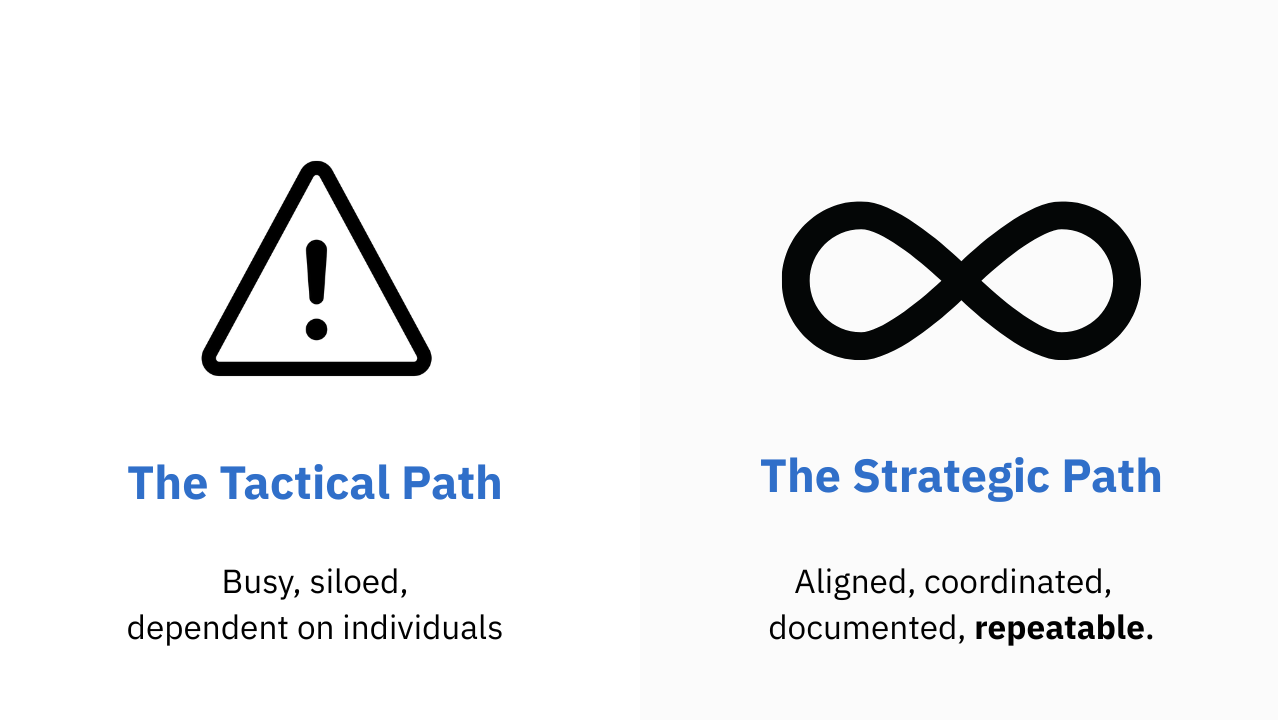
The pressure you feel to "do something with AI" is exactly what makes the tactical path so seductive. Point solutions are fast. System redesign is slow and uncertain. The rational response to board pressure is to launch pilots.
That rational response is what's killing you.
The organizations that escape don't just measure differently. The organizations that escape understand that transformation requires redesigning systems, not just adding tools.
This means:
Workflows have to bend. You can't layer AI onto rigid processes and expect magic. The successful companies we work with rebuild workflows to accommodate what AI makes possible. This takes longer than buying licenses. It also works.
People need practice space. Learning happens through experimentation, not through training modules. The minority creates protected environments where people can try AI on low-stakes work before handing it high-value tasks. Most companies skip this step, then wonder why adoption stalls.
Leadership must speak plainly. Your team knows when you're faking confidence. If you can't explain your AI strategy without buzzwords, they won't trust you to guide them through it. We've sat in too many all-hands meetings where executives read corporate talking points about "transformation journey" while employees check out.
The companies that win build these foundations before they scale. It looks slow. It looks expensive. It's neither. What's expensive is launching 47 pilots that go nowhere.
The Real Question
You already know what you should do. You've probably known for six months.
Are you willing to do what it takes to escape the trap?
That means having a harder conversation with your board than showing them the pilot dashboard. It means pausing some initiatives to build the capabilities that make the rest possible. It means measuring readiness when everyone else measures activity.
Most won't make this choice. The competitive pressure is too strong. The board pressure is too real. The tactical path is too tempting.
But the ones who do will separate permanently from the ones who don't.
We've built a diagnostic based on ARC to show you exactly where your organization stands. Not to grade you, but to show you which path you're on, regardless of what your dashboards say.
This isn't about having better information. You have plenty of information. This is about having the courage to measure what matters when everyone else is measuring what looks good in quarterly reviews.
In our next piece, we'll show you how to calculate your ARC score and why companies that skip resilience pay for it twice.
We recorded our Q4 2025 Executive Reality Check last month, walking through the two paths we're seeing in detail. The tactical path that 80% are stuck on, and the strategic path the minority are building. If you want to see the full breakdown of where these patterns lead and what the separation looks like in practice, it's worth 20 minutes of your time.
The AI problem you’re facing isn't just technical. It's whether you're willing to build different when everyone else is building fast.
Your Q2 2026 board meeting is closer than you think.